
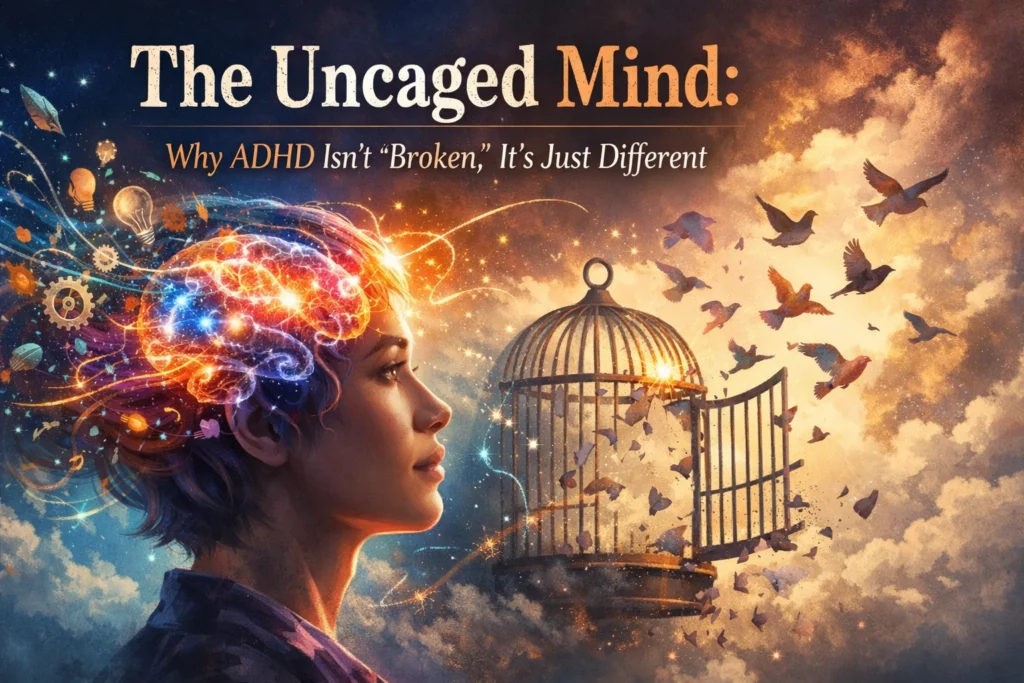
If you’ve ever felt like your brain (or your child’s brain) is a Ferrari engine with bicycle brakes, you’re not alone. For a long time, the world has looked at ADHD as a "disorder", a list of things that are missing, broken, or "less than." We talk about deficits in attention and hyperactivity as if they are malfunctions in the human machine.
But what if we’ve been looking at it all wrong?
Recently, Christopher Lembke shared a powerful perspective on LinkedIn that we really resonated with here at Anchor Apparel. He argued that the world needs to catch up to the ADHD brain, not the other way around. He calls it the "Uncaged Mind."
At its core, ADHD isn't a collection of broken parts. It’s a different operating system entirely. If most of the world is running on Windows, the ADHD brain is running on a high-speed, custom-built Linux build. It’s not "worse"; it just processes information, energy, and the environment in a way that the standard "user manual" wasn't written for.
It’s Hardware, Not a Glitch
One of the most important things for every "Guardian" (that’s you, the parent or caregiver) to understand is that ADHD is neurodevelopmental and genetic. It is baked into the hardware.
There’s a lot of noise out there suggesting that ADHD is caused by too much sugar, too many video games, or "lazy" parenting. Let’s set the record straight: that’s total nonsense. You wouldn't blame a child’s height on their diet of cartoons, and you can’t blame a neurodivergent brain on lifestyle choices.
The "Navigator" (the child or teen navigating this world) has a brain that is literally wired to seek out stimulation, to jump between ideas at lightning speed, and to notice the three things in the room that everyone else is ignoring. This isn't a choice they make; it’s who they are.

The World Wasn't Built for Navigators
Imagine trying to drive that Ferrari engine we mentioned earlier through a school zone that has a speed limit of 5 miles per hour, every single day. That’s what a typical classroom feels like for a Navigator.
The world, schools, offices, even social gatherings, is largely built for "typical" brains. It’s built for sitting still, following linear instructions, and filtering out background noise effortlessly. When a Navigator struggles to do these things, we often label it as a failure.
But as Lembke points out, it’s not the mind that’s the problem; it’s the cage. We try to cage these fast-moving, creative, and highly sensitive minds into boxes that are too small for them. When they hit the sides of the cage, we call it "behavioral issues."
We think it’s time to stop trying to shrink the mind to fit the cage and start building a world that actually gives the Navigator room to move.
Reframing the "Symptoms"
When we change our perspective from "broken" to "different," the way we describe ADHD changes too:
- Distractibility becomes High Situational Awareness. They aren't "unfocused"; they are focusing on everything at once.
- Impulsivity becomes Quick Decision Making. They have a bias toward action that can lead to incredible creativity and bravery.
- Hyperactivity becomes Abundant Energy. It’s a drive that, when harnessed, can power through projects that would exhaust anyone else.
- Hyper-focus becomes Deep Mastery. When a Navigator finds something they love, they don't just learn it; they become an expert in it overnight.
The goal for any Guardian isn’t to "fix" these traits. It’s to provide the tools that help the Navigator manage the friction of living in a world that moves a little too slowly for them.

Enter Stealth Stimming: Regulation Without the Stigma
This is where Anchor Apparel comes in. We know that for a Navigator to thrive, they need to stay regulated. Their nervous system is often on high alert, taking in more sensory data than they know what to do with.
Traditionally, the "tools" given to kids with ADHD or sensory needs look… well, medical. They look like therapy equipment. While those tools are great, they can sometimes make a Navigator feel like they’re standing out for the wrong reasons. They might feel like they’re carrying a sign that says, "I’m different."
We believe in Stealth Stimming.
Stealth stimming is the idea of providing sensory regulation: like weight, compression, or tactile input: through everyday clothing that looks just like what everyone else is wearing. It’s a "secret weapon" for the Navigator.

When a child wears a weighted hoodie or a compression shirt that looks like a standard tee, they aren't just getting the sensory input their brain craves to stay calm and focused. They’re also getting the confidence of fitting in. They can "stim" (self-stimulate to regulate their nervous system) discreetly.
Whether it’s the gentle pressure of a weighted hem that feels like a constant hug or a fabric texture that provides a calming touchpoint, these aren't "medical devices." They are tools for the Uncaged Mind.
Why "Stealth" Matters
For a teen or a kid in middle school, social dynamics are everything. They want to be themselves, but they don't necessarily want to explain their neurobiology to every kid in the hallway.
Stealth tools allow the Navigator to take control of their own regulation without having to have a conversation about it. It moves the focus away from the "disorder" and puts it back on the person. It says, "I have what I need to succeed, and I look good doing it."

A Note to the Guardians
We know it’s not always easy. Being a Guardian to a Navigator is a role that requires more patience, advocacy, and out-of-the-box thinking than most parents will ever understand.
You spend your days translating the world for your child and translating your child for the world. You’re the one making sure the "cage" stays open as wide as possible so their mind can fly.
Remember: you aren't trying to "cure" your child. You are helping them find their "user manual." You are giving them the tools: whether that’s a specific routine, a different way of learning, or a piece of sensory clothing: that allows their "operating system" to run smoothly.
The Future is Neurodiverse
The world needs Uncaged Minds. We need the people who see the patterns others miss. We need the creators who can’t help but think of ten ideas while everyone else is still on the first one. We need the "Ferrari engines" to push us forward.
Our job at Anchor Apparel is simple: we want to make sure those minds are comfortable, regulated, and confident while they do it.
ADHD isn't a deficit of character or a failure of the brain. It’s a different way of being human. And honestly? We think the world is a whole lot more interesting because of it.

So, next time your Navigator is moving a mile a minute or your own ADHD brain feels like it’s overheating, take a breath. You aren't broken. You’re just running a high-performance system in a world that’s still catching up.
Stay anchored, stay bold, and keep that mind uncaged.
: Joe Annotti
Founder, Anchor Apparel LLC